"I Was Almost Their Soldier"
A story from a Save Ukraine recovery center · Identifying details changed to protect family still under occupation
My name is Taras. That is not my real name — I cannot tell you my real one, because my family is still in danger.
I am eighteen years old. I have a little sister and two older brothers. We grew up in a small village in the south of Ukraine. The russians came when I was twelve, and for four years they tried to teach me how to be one of them.
In their school, we were not allowed to speak Ukrainian. Not even Surzhyk — the half-and-half village language my grandmother used. The teachers told us: “Forget the word ‘Ukraine.’ This is russia now. You are russian.” They made us memorize their anthem. They made us swear oaths to a country that was not ours. There was a movement at our school called “The First Movement” — a children’s organization for “patriotism.” It was not patriotism. It was a slow rewriting of who we were.
My little sister stopped talking somewhere in the middle of all that. She would come home from school and not say a word. She lost two years of real schooling — they put her in 7th grade when she should have been in 9th.
A few days after I finished 9th grade, the conscription notice came. I was seventeen.
I went to the military commission, because if I did not, they said they would put me in prison. They gave me a test with two hundred questions. Are you mentally well? How do you feel about terrorism? How do you feel about the army? Are you a patriot — yes or no? I knew there was only one set of answers that would let me walk back out. I gave them every one.
When I was done, an officer leaned over and told me: “It is not so scary. Sign a contract. You will train as an officer. They will not send you to the front.” He said it the way you would talk to a child about going to summer camp.
I was about to turn eighteen, and they wanted me to sign a paper that would make me a soldier in their army. To shoot at my own country. If I did not sign, they could draft me anyway.
My mother had been afraid of this since I was thirteen. She told me: “In our family, only your sister is going into any army — and only into ours.”
She got us out weeks before my next appointment at the military commission.
One of my brothers found Save Ukraine, and they organized everything. We crossed at night. The hardest moment was at the russian border — my oldest brother lost a leg last year from medical neglect, and the russian soldiers kept questioning him. They thought he might be a Ukrainian soldier who had fled and come back. They eventually let us through.
My sister and I are at a Save Ukraine center near Kyiv now. I am cooking again — I have always wanted to be a chef, and the staff lets me help in the kitchen. My sister takes English lessons every day. The first time she came home from class, she said, “Mom, this is so cool.” I had not heard her say something was cool in three years.
We are going to study. We are going to live a life that is not measured in conscription notices.
I will not be their soldier. I will not be anyone’s soldier. I am going to cook in a free country.
I drew this because I am free. Because they did not get me. Because my sister is talking again.
Thank you for bringing us home. And please — thousands of children like us are still waiting to be rescued.
— Taras, 18
At a Save Ukraine recovery center near Kyiv, children — recently rescued from russian occupation — sat down with paints and brushes. Art therapy is part of how they begin to heal here: to put down on paper what they could not say out loud for years. They made these drawings for our friends in the USA — to thank you for standing with Ukraine, and to remind the world that thousands of Ukrainian children are still waiting to come home.
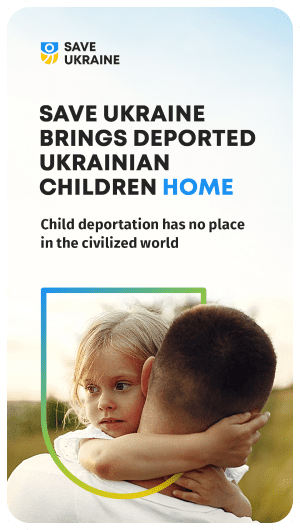
Save Ukraine has brought thousands of children home from russian occupation, and we walk with them through the years of healing that follow. Thousands more are still waiting.
Learn more about our work and support the rescue at saveukraineua.org
Help us bring the next child home.
You can share the post: